
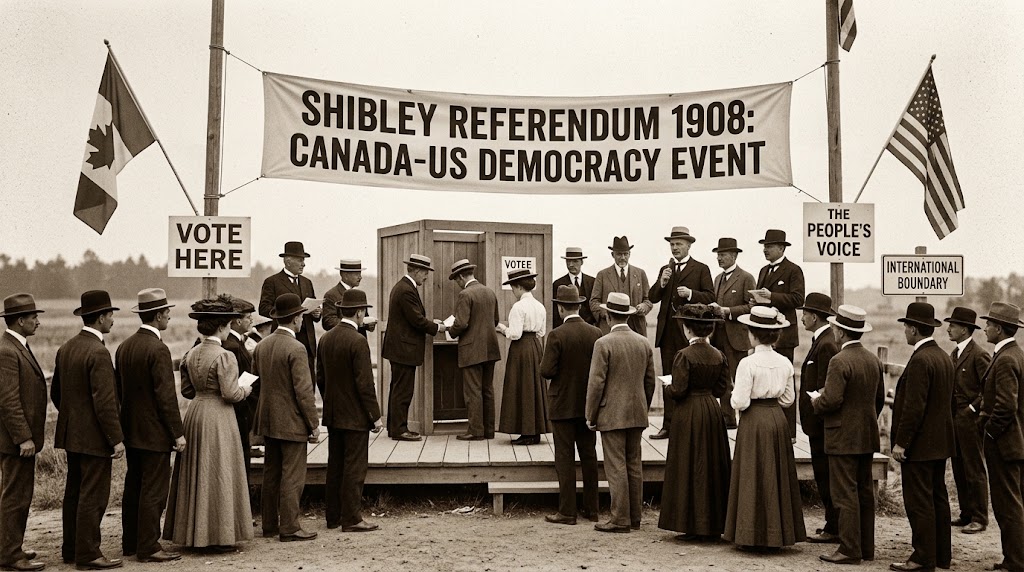
The Shibley Referendum Act: Promise, Suppression, and the Road Not Taken
AI Summary
- Source & author
- Ontario Legislative Assembly, 1908 Statutes; Hansard debates; provincial order-in-council archives; Canadian political history scholarship; Progressive Era movement records
- Key points
- Sponsored by farmer-legislator Joseph W. Shibley, the Ontario Referendum Act, 1908 would have allowed 10% of registered voters to propose or repeal laws via direct ballot, with results binding the legislature — the first such statute at provincial or state level in Canada. It passed with cross-party support and received Royal Assent on May 25, but the Conservative government withheld the required proclamation to bring it into force. Repealed in 1912 without ever being used, it stands as a defining case of formal democratic reform that was legislated but never activated.
- Evidence cited
- Full text of the Act showing proclamation dependency; petitions from 1909–1911 demanding activation; comparison with South Dakota (1898) and Oregon (1902) initiative systems; United Farmers of Ontario policy platforms; cabinet correspondence confirming deliberate delay; 1912 repeal statute; modern comparative data on initiative use across 24 US states.
What This Means
For Canada
The Shibley Act established a pattern that persists today: citizen-initiated direct democracy is repeatedly debated but never entrenched at the national or provincial level. Every Ontario referendum held since — on prohibition in 1919, electoral reform in 2007 — was called by the government, not the people. The power to put a question to the vote remains controlled by those who would lose power if the mechanism were shared.
For the United States
The contrast is stark and instructive. While Western states embedded initiative/referendum systems that remain in daily use, Canada’s single attempt was stopped before it began. This divergence demonstrates that Progressive Era reform succeeded where populist movements captured state machinery, and stalled where established parties retained control of implementation — a lesson still visible in state-level fights over ballot access today.
For world democracy
The Act reveals a universal vulnerability: when a reform law requires action by the very people who stand to lose from it, it may never be activated. “Passing the law” is only half the battle; the other half is securing independent enforcement. Where that safeguard is missing — from Shibley’s Ontario to modern democracies everywhere — power yields nothing without pressure.
The Debate in 1908 — Arguments For
- Restore ownership to the people: Legislatures had fallen under the influence of railway, timber, and corporate interests that funded campaigns and shaped policy. Shibley argued representatives were no longer accountable to constituents — citizens needed a direct mechanism to bypass captured institutions and reclaim sovereignty.
- Complement, not replace, representation: The initiative was intended as a check, not a replacement. It would activate only when the legislature failed to act — giving citizens a remedy for inaction or corruption without removing the day-to-day work of governance from elected bodies.
- Proven success elsewhere: South Dakota had operated the system for a decade; Oregon had seen sweeping reforms enacted by popular vote that their legislature had refused to consider. These were not theoretical ideas — they were functioning tools that had curbed monopoly power and advanced social policy.
- Strengthen trust in institutions: Giving citizens a share in lawmaking would restore faith in democracy itself. Instead of disengagement and cynicism, people would see their input produce tangible results — a principle that has guided participatory design ever since.
The Debate in 1908 — Arguments Against
- Majority rule without safeguards: There was no mechanism to protect minority interests or ensure deliberation before a vote. A determined, well-organised faction could propose sweeping changes and pass them before opponents could mount a defence — creating a tyranny of the majority.
- Complexity reduced to yes/no: Taxation, resource management, and infrastructure policy involve trade-offs that cannot be captured in a single question. Nuance, compromise, and expert consideration — the work of legislatures — would be discarded in favour of the simplest, most emotionally resonant framing.
- Special interests would dominate: Gathering signatures and campaigning requires money. Critics warned the system would not empower ordinary citizens but the best-funded groups — exactly the opposite of its stated purpose. The side able to pay organisers and buy advertising would set the agenda.
- Paralysis and instability: Frequent ballot measures would distract from essential governance, divide communities, and bind future governments to inflexible constitutional-level decisions made by temporary majorities. The legislature would become secondary to a perpetual campaign cycle.
The Road Not Taken — What Might Have Been
If the Shibley Act had been proclaimed and allowed to operate, the trajectory of Canadian and North American democracy could have shifted in measurable ways:
- Policy divergence: The prohibition question — delayed and divisive — might have been settled decisively by citizens in 1909 rather than left to split parties for a generation. Workers’ rights, resource management, and public ownership of utilities could have been advanced by popular vote when legislatures stalled.
- Political realignment: The United Farmers and Progressive movements would have had a direct legislative tool to advance their platforms without needing to capture a majority in the assembly. Third-party influence — historically weak in Canada — could have been institutionalised through the ballot rather than suppressed by the first-past-the-post system.
- Regional balance: Western provinces — where populist sentiment was strongest — might have adopted similar systems sooner, creating a counterweight to centralised authority in Ottawa and Toronto. The gap between federal policy and regional preference might have narrowed through direct channels.
- Global reference model: A functioning initiative system in a parliamentary democracy would have provided a third major example alongside Switzerland and the Western US — one tailored to the Westminster tradition. Emerging democracies in the 20th century might have adopted “Shibley-style” mechanisms rather than choosing between the Swiss and American models alone.
- The counterfactual risk: Opponents’ warnings might also have been borne out — polarising campaigns, wealthy interests dominating access, and poorly drafted laws producing unintended consequences. Without the moderating influence of legislative revision, citizen-led measures could have created new problems that would then require further reform to fix.
Legacy and Lessons for Today
- Design matters most: The fatal flaw was not the concept — it was the missing enforcement mechanism. The Act depended on the very government it would constrain to launch itself. Every modern proposal now includes independent activation, automatic timelines, or citizen oversight bodies to avoid repeating this.
- Passage ≠ power: Reformers worldwide now know that getting a law passed is only the first step. Implementation, funding, and independent oversight must be written into the text from day one — otherwise, delay and quiet repeal remain the default response.
- The demand persists: From recall movements in Poland to participatory budgeting in Bogotá, the impulse behind Shibley’s Act remains alive. The question is no longer whether citizens want more control — it is whether those who hold power will design systems that actually deliver it.
Is your area run democratically by the people? Or by politicians? Are you interested in people empowerment for democracy in your area?
Leave us your details, we will be in touch.